
Genealogy
To construct this branch genealogy, we propose relying on three authors:
- Sir Peter Leycester: English historian (1614-1678), author of “The Pedigrees of Cheshire.”
- George Ormerod: English historian (1785-1873)
- Katherine Gearhart: American genealogist, author of: « The Barons of Kinderton ».
- Are these authors historical figures for you?
- Which authors would you like to include?
- What are your thoughts on this topic?
Venables Généalogie – by Sir Peter Leycester
Biography:
Sir Peter Leycester, 1st Baronet (also known as Sir Peter Leicester) (3 March 1614 – 11 October 1678) was an English antiquarian and historian. He was born in Nether Tabley, near Knutsford, Cheshire, England, the eldest son of Peter Leycester (1588–1647) and Elizabeth Mainwaring, daughter of Sir Randle Mainwaring of Over Peover, Cheshire. He entered Brasenose College, Oxford, in 1629 as a commoner but did not graduate. In 1632, he was admitted to Gray’s Inn.
When the Civil War broke out, he was appointed one of the King’s Commissioners of Arrangement for Cheshire. He was in Oxford in June 1646 when the city surrendered to Thomas Fairfax. Consequently, he was relieved of other responsibilities and had time to develop his interest in antiquarian research. Among the subjects he studied was the pedigree of the Mainwaring family. In 1642, he married Elizabeth Gerard. In 1649, he purchased a transcription of the section of the Domesday Book relating to Cheshire.
In 1655, he served a period of imprisonment, but after the Restoration, he was released and returned to the bench as a Justice of the Peace. In this capacity, according to a modern historian, he harangued grand juries with warnings about the constant dangers of sedition and revolution, and the need to maintain vigilant surveillance over all Roman Catholics, especially Jesuits, as well as Republicans, Puritans, and all those who threatened the existing social order.
He was created a baronet in 1660 in recognition of his loyalty to the Royalist cause. He was involved in the English Civil War on the Royalist side and was subsequently created a baronet. He became embroiled in a controversy with the Mainwaring family. He developed a library in his home at Tabley Old Hallet and made improvements to the house and estate, including the construction of a private chapel on the grounds. He was an active and conscientious Justice of the Peace and used his position on the bench to expound his staunchly Conservative and Royalist political views.
His work:
His major historical work appeared in 1673, its full title being Historical Antiquities in Two Books; the first dealing generally with Great Britain and Ireland; the second containing particular remarks concerning Cheshire, and chiefly with “the Bucklow Hundred.” To this is appended a transcription of the Domesday Book, where, with regard to Cheshire, it is generally referred to by the shorter title of Historical Antiquities.
In the book, Leycester presented a discussion concerning the legitimacy of Amicia, the wife of Ralph Mainwaring, as to whether or not she was the legitimate daughter of Earl Hugh Cyveliok. This led to a dispute with Sir Thomas Mainwaring of Peover, one of his descendants, who in 1673 published a “Defense of Amicia.” Leycester responded later that year with “An Answer to the Book of Sir Thomas Mainwaring.” In 1675, the itinerant judges at the Chester Assizes ruled in favour of Amicia’s legitimacy.
Venables Genealogy – by George Ormerod
Biography:
George Ormerod was born in Manchester on October 20, 1785. He was initially educated privately, then briefly at the King’s School in Chester, before continuing his studies privately under the Reverend Thomas Bancroft, Vicar of Bolton. He entered Brasenose College, Oxford, in 1803, obtained a BA in 1806, and received an honorary MA in 1807.
In 1806, upon reaching his majority, he inherited extensive estates in Tyldesley and southern Lancashire. In 1808, he married Sarah Latham, the daughter of John Latham (1761–1843), a physician living at Bradwall Hall, Sandbach. After their marriage, they initially lived in Rawtenstall but moved to Great Missenden the following year. In 1810, he was the tenant of Damhouse in Astley.
At this time, he had become involved in research on the history of Cheshire, and to facilitate this task, he purchased the house and estate of Chorlton, four miles from Chester. He lived in this house from 1811 to 1823. When this historical work was completed, he moved to Gloucestershire, purchasing the Barnesville estate in Sedbury, which he renamed Sedbury Park. He lived there from 1828 until his death. There, he was appointed a Justice of the Peace and served as a Sub-Lieutenant for Gloucestershire in 1861. He died at Sedbury Park on October 9, 1873, and was buried nearby in Tidenham.
His work:
The full title of the work is “The History of the County Palatine and City of Chester…”, incorporated with a republication of the antiquities of King’s Vale Royal and Leycester in Cheshire (see Bibliography). An extremely rare initial printing in two volumes with duplicate plates was followed by a ten-part general subscription, which comprised three volumes, between 1816 and 1819.
Much of his research was based on documents held at Chester Castle and on books and papers lent to him by Hugh Cholmondeley, Dean of Chester. He also borrowed material from some of the leading families in the county. Much of the transcription of these records was carried out by the Reverend J. Eaton, his research assistant, and by Faithful Thomas, the sub-keeper of the archives at Chester Castle. Ormerod toured the county and claimed to have visited every township at least once.
Like other county histories of the period, the work consists mainly of family history, manorial history, and antiquarian topography. It deliberately excluded any reference to commerce, industry, and urbanization. Between a quarter and a third of the work was written by Ormerod himself, while the remainder consists of transcriptions of documents and reprints of earlier works. A second, revised and enlarged edition of the work was prepared by Thomas Helsby and published between 1875 and 1882. He was elected a Fellow of the Royal Society in 1819.
Link:
The History of the County Palatine and City of Chester: Comp. from Original … – George Ormerod – Google Livres
Les Barons de Kinderton – by Katherine GEARHART
Biography:
It is impossible to write a family history spanning over 1,000 years without errors or misunderstandings. For this reason, I have included as many collateral family lines as reasonably possible, with the intention that we might then gain a better understanding of the Venables family and its history, knowing that even if I had incorrectly linked generations, the story of Abraham’s family line would still have been told. The ultimate goal was to find Abraham Venables, our first immigrant to Virginia in 1679. I believe he has been found and his family correctly identified.
Abraham Venables was baptized in 1654 in Hertford, Hertfordshire, at All Saints Church. His father was Abraham Venables, but there is no record of his mother.
My sources are all available online, either free of charge or by subscription, including parish and historical records. These volumes were of significant help in preparing the first 500 years of history.
- Visit to Cheshire in 1580
- Pedigrees of Sir Peter Leycester of Cheshire
- The History of the County Palatine and the City of Chester by George Ormerod
- Some Venetian Men of England and America…, by Henrietta Brady Brown
The English Venables archives begin in Cheshire, with the first branches in Staffordshire and London. In the late 1500s, England experienced a population boom, and churches began recording births, deaths, and marriages, although this was often sporadic and haphazard. Before this time, landless but law-abiding individuals were virtually invisible in history. It is primarily through land, court, or tax records that men, and sometimes women, are documented.
The name Abraham is first documented in 1604 with the birth of Abraham to Raphe Venables in London, who was almost certainly from Cheshire. Shortly thereafter, there are birth records of Abraham in Staffordshire and Hertfordshire.
Regarding parish registers of births, deaths, and marriages, I quote from the Internet London Lives: Despite their seemingly complete coverage, it is important to note that the parish registers suffered from a significant degree of under-registration. Those who were not members of the Church of England, particularly dissenters, often failed to register these events, especially marriages, with their Anglican minister. It is also important to note that there was often a delay between births and baptisms, and that the births of children who died before being baptized were frequently not recorded.
Clandestine marriages, which took place outside the parish, were not recorded in the parish registers, although their incidence fell dramatically after the passage of the Duty of Marriage Act of 1694, which imposed heavy fines for failure to register marriages (although with a centre for clandestine marriages, Holy Trinity Minories, immediately adjacent to St Botolph Aldgate, this possibility should not be ignored).
Finally, not all deaths within a parish resulted in burials within that parish, as some bodies were returned by parish officials to the individual’s home parish, or by families to a family vault in another parish.
Levels of under-registration varied from parish to parish and according to the type of event. It has been estimated that in late 17th-century London, under-registration of births caused by religious dissent accounted for approximately 17% of all births, with another unknown percentage of births missing due to infant mortality before baptism.
In contrast, the under-registration of marriages, particularly after 1694, and of deaths, was considerably lower. While there is no reason to question the accuracy of the data provided, the fact that an event was not recorded in a parish register does not mean that it did not occur in the parish.
To learn more about the research conducted by Katherine GEARHART click here
Letters from Dorothy Mary Faith Venables
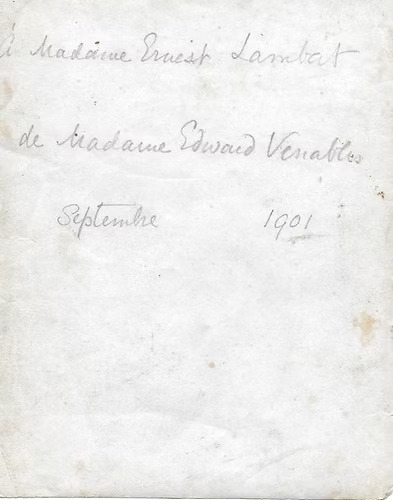
A resident of Venables, Mrs. Christiane Lallemand, donated two letters and a photograph to the “Gilbert de Venables” Cultural Center. Written in perfect French by Dorothy Mary Faith Venables, they are addressed to Mrs. Ernest Lambert, a fellow resident of the village. These letters were written after a trip that allowed Dorothy to visit and discover Venables in 1901.
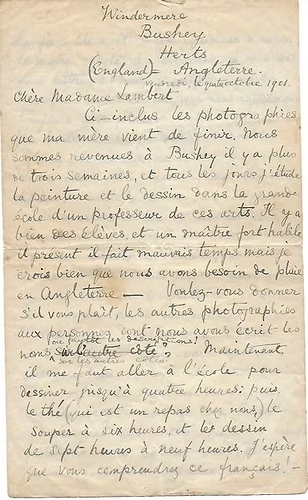
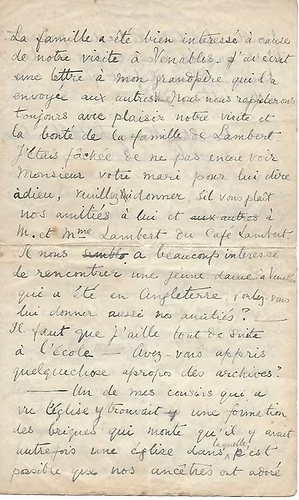
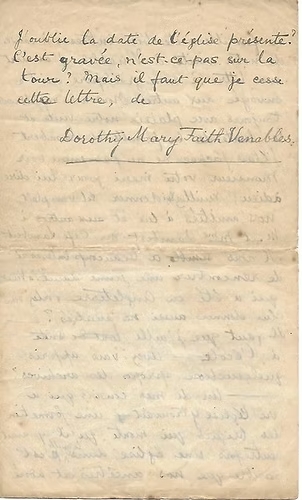
Letter dated October 4, 1901
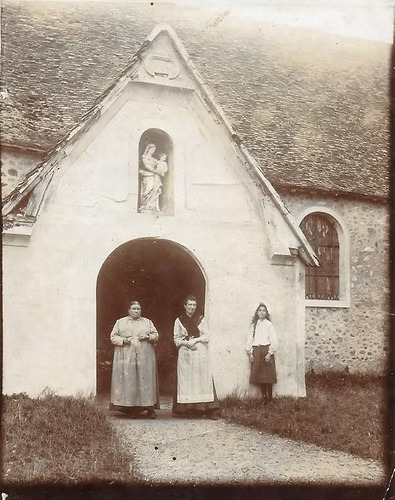
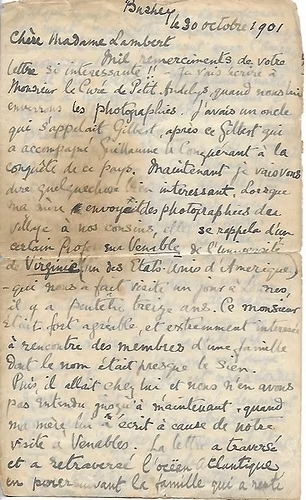
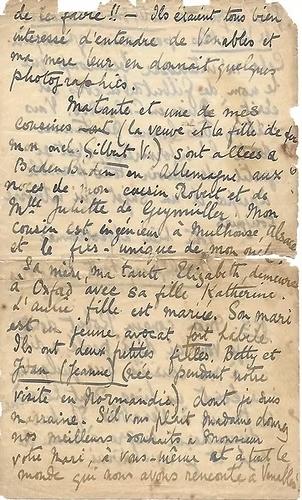
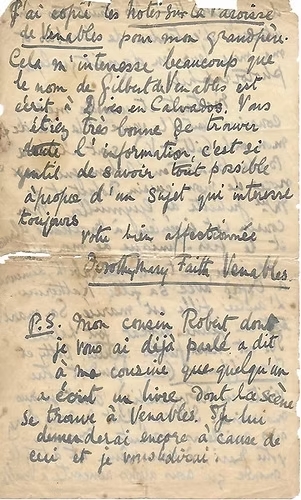
Letter of October 30, 1901
Dear friends of Venables, if you have any information about Dorothy Mary Faith Venables, please send it to us to complete our Contact page.
INITIAL RESEARCH ON: DOROTHY MARY FAITH VENABLES
Dorothy visited Venables in September 1901, likely accompanied by her mother. She was 19 years old and lived in Bushey, England.
She corresponded with Mr. and Mrs. Lambert Arnès (Ernest and Noémie). The 1901 census in Venables lists Ernest as a saddler and Noémie as a homemaker.
Information found on Familysearch.com, Ancestry, and Geneanet for Dorothy.
- Date of birth: November 6, 1882
- Date of baptism: December 2, 1882, at Saint Anne’s, Westminster, Middlesex, England
- Her parents: Mr. Edward Venables and her mother, Mrs. Edith Mary. She had a younger sister, Persis Elizabeth Venables[1], born in 1889 and died on December 7, 1913, in Veytaux Chillon, Switzerland. According to the census, her mother was living alone; her father had died in 1891.
In 1906, at the age of 24, Dorothy boarded the Caronia alone in Liverpool to join a cousin in Charlottesville, Virginia. (Passenger list for this ship)[2].
She returned to England a year later and married Mr. Humphrey George Ambose Baker, born in 1882 in Oxford, on June 5, 1910, at Holly Trinity Church, Maryleborne, London.
In 1911, Dorothy and her husband were living in Kensington, London (1911 census). They also had a maid.
In her letters, Dorothy tells us about a mathematics professor from the University of Virginia who came to visit them in London 13 years earlier, in 1888. Her mother sent her a letter, but the professor had died on August 11, 1900. It was his wife who received his letter, and during a visit to London, she gave Dorothy an almanac containing photos of the university.
So this professor’s name was Charles Scott Venable (without an S), and a school was opened in 1925 and bears his name, Venable School[3]. This professor’s career is described on the website encyclopediavirginie.org.
Authors: Marie Christine Marchand and Nadine Olivier (May 2024)
[1] Persis Elizabeth Venables: born in 1889, she would have been 12 years old if she came to France. We assume she is the person on the right in the porch photo.
[2] According to the details in the Passenger Book, Dorothy travels alone.
[3] The school was opened in 1925 and is named after her: Venable Elementary School: https://venable.charlottesvilleschools.org/