
The Origins of the Name Venables
Continued
The relationship between L’if and the name Venables:
Les Ifs is the name of a part of the municipal territory located within a natural perimeter formed by the Gournay ravine and the Fausse Louvel. It is within this perimeter that the oldest human settlements can be found, dating from the Middle Palaeolithic period (-40,000 years) to the Roman occupation of Gaul.
Throughout this period, the first traces of temporary occupation were left by Neanderthals until the Neolithic period. At the end of the Neolithic period, proto-Celtic tribes settled in the area, leaving the plateau to occupy the terraces near the river, which was reforming due to the warming climate during this period.
Mastery of metallurgy led to the first major intense and complex economic exchanges based on production and distribution covering vast territories. These exchanges encouraged the first major migrations of populations from Central Europe in the 8th and 7th centuries BCE. These populations were known as Celts (keltoi) by Greek authors and Galli by Latin authors.
In the 4th and 3rd centuries BCE, a second migration of tribes from the La Tène period led to the partial settlement of populations in the Seine valley and mainly on the Belvedere. These Celtic migrations were based on a princely and warrior aristocracy without political unity.
The yew tree played an important role in Celtic-Gaulish cosmology and religion. The symbolism of the horse, the boar and the yew tree is widely represented on the potins (1) found in the municipal area.
(1) Gaulish potins are bronze coins that were cast rather than minted.
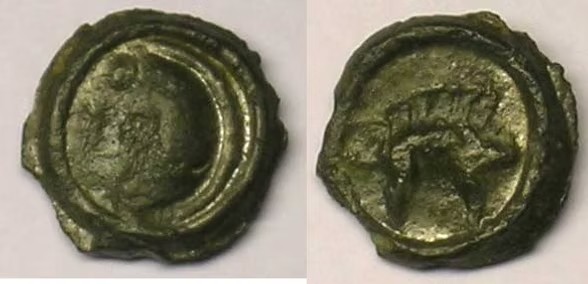
The Celtic/Gaulish influence on the name Venables
In the 2nd century BC, the Aulerci-Eburovices (1) people, ‘those who conquer with the yew tree (2)’, descended from the Germanic Aulerci tribe, settled mainly throughout the territory of what is now the Eure department. Their settlements in the commune were mainly located within the perimeter described above, as evidenced by traces of a Celto-Gaulish occupation on the site of a hamlet in the commune located on a Celtic road between two large civitas connecting Evreux and Les Andelys.
Over the past several decades, historical and archaeological studies have advanced considerably, giving us a better understanding of the formation of the first Gallic village structures. These sites consisted of small farms run by free peasants on small units called ‘Vici’, where family clans lived in complete self-sufficiency with limited communication and trade.
It was the settlement of the Aulerci-Eburovices tribal clans, with their culture and religious symbols, that certainly influenced the early terminology and future name of ‘Venables’ and its motto.
Latin etymology study:
Aulerci: ‘Those who are’ Far from their traces. This term expresses the idea of separation or distancing of a people who settle far from their origins (3).
Eburo: Two meanings are given to designate an animal, ‘the boar,’ or a tree, ‘the yew’ (4), which are symbols of their belief in nature. The yew, due to its longevity and robustness, was reserved for the manufacture of weapons and tools.
Vice: The term has been linked to the Latin vincere (vincō, vīcī), meaning to conquer or to fight (5).
This etymology gives rise to two symbols:
Hunting: Those who conquer the wild boar with a spear carved from yew wood.
War: Those who conquer with a spear carved from yew wood.
The current motto ‘Venabulis Vinco’ ‘Conquer with the spear’. The second symbolism is the most plausible explanation for its origin. It is related to the name given to a part of the municipal territory, ‘Les Ifs’ (The Yews). This is a place where we find the oldest traces of settlements during the Celto-Gaulish period.
1) – Auguste le Prévost: History of the Eure department and its municipalities, volume 1
2) – The yew tree was sacred to the Aulerci-Eburovices.
3) – Xavier Delamarre: Dictionary of the Gallic language
4) – Auguste Le Prévost: Memoir and historical and archaeological note on the Eure department
5) – Jacques Lacroix: Names of Gaulish origin – the Gauls of battle.
The Celtic/Gaulish symbolism of the yew tree
The yew tree grew in dense forests during Celtic times. The Celts believed that the yew tree descended from the God of Death. They chose the yew tree to represent this reality because they had already noticed its extreme longevity, and even its ability to perpetuate itself eternally through its root suckers. The yew tree plays an important role in Celtic-Gaulish cosmology and religion.
Our ancestors showed it great respect, as the yew was a sacred tree symbolising the link between earth and sky. It occupied an important place in various mythologies and featured in a large number of legends and popular traditions, convinced of the existence of life in the afterlife and, consequently, the immortality of the soul. The Celts had a very “natural” view of eternal life, inspired by the infinite cycles they could observe around them: the rebirth of nature in spring after its death in late autumn, the ebb and flow of water, the perpetual movement of the stars in the sky… Eternal disappearance, eternal renewal.
Unlike other sacred trees, yews had a very unique symbolic meaning and were not believed to personify a deity. Our ancestors quickly realised that the yew tree had some very interesting qualities. Its high-quality red wood had many uses and, thanks to its flexibility, could be used to make long-range bows and arrows, which were coated with a decoction made from crushed dried leaves. (1) Its fibrous bark was also used to make fairly coarse fabrics.
The Gallo-Roman
During the conquest of Gaul, the Romans rarely dared venture into the dark yew forests. Driven by their vision to impose a new civilization and religion, the Romans razed the yew forests and literally banished them from the conquered territories, as they were associated with the worship of the occupied people. The Romans laid the first stones of the rejection of the nature-based beliefs that existed in the occupied land. The Celto-Gauls worshipped numerous deities who were originally gods of vegetation, war, and also tutelary (protective) deities. To impose their civilization and demonstrate their determination within the communal territory, the Romans established a Pars Urbana of approximately five hectares on the ancient sacred Druidic sites and buried their dead in the same cemeteries. They would thus conspicuously separate humans from other species (these other species becoming “Nature”). But while the Latin language will impose a new etymology, the Celtic/Gallic symbols will endure.
1) The Gauls, and later the Romans, poisoned their arrows with a decoction of yew leaves and sap. Julius Caesar (100-44 BC) reports in his Commentaries on the Gallic War (Book V, chapters 24 and 26, Book VI, chapter 31) that Catuvolcus, king of the Eburones, who occupied part of present-day Belgium, poisoned himself with yew in 53 BC.
Latin Influences
The Latin language further developed the primary etymology of the name, resulting in the following forms:
VENABELEN, from the word VEN, meaning mountain, and BELENOS, referring to the Gaulish Celtic god associated with light and the sun.
VENATIO: Combat between or against wild animals in circus games, or designating a hunting ground.
VENERIS: Temple dedicated to Venus.
VENA (Vénae): designates a vein (metal vein, stream of water).
VENABULUM refers to a hunter’s spear (1)
1st century BC, name used by Cicero
A type of half-pike, with a narrow but very wide head; this is why Virgil said: lato venabula ferro; it was used for hunting wild animals.
In the 13th century, the administrative and military center of the village was called VENABLIS and VENABULA.
1) – Gaffiot, Félix (1934) Illustrated Latin-French Dictionary, Hachette
– Harry Thurston Peck, editor (1898) Harper’s Dictionary of Classical Antiquities, New York: Harper & Brothers.
– William Smith et al., editor (1890) A Dictionary of Greek and Roman Antiquities, London: William Wayte. G. E. Marindin.
The Yew
The yew belongs to the Taxaceae family. These species were already present at the beginning of the Tertiary period, and fossilized imprints even suggest that it existed as early as the Triassic period (200 million years ago). It is a resinous tree, but it does not produce resin. It is a conifer, but without cones. It is a tree with highly toxic wood.
The only condition is not to consume its seeds (red) and leaves (dark green) in a decoction, as these contain taxine (1), a highly toxic substance that can cause cardiac arrest. From the outside, its growth is very slow (30 cm in height and 2 mm in diameter per year) and rather chaotically. It is easy to carve, which can also help with identification. Some specimens stand out due to their exceptional longevity. They can live for several hundred years, reach a height of approximately 15 to 20 meters, and a circumference of 5 to 10 meters.
From the inside, the yew’s sap flows under the bark, not through the trunk. Because of its longevity and evergreen nature, an ancient belief associated the yew with immortality. It holds a special place in the Celto-Gallic calendar, which held it in particular veneration.
When the Romans invaded Gaul, they destroyed this tree en masse, seeking to eradicate one of the symbols of religious life in Gaul and impose their own. It was gradually driven out of agricultural areas, particularly hedgerows, to find a privileged place in locations such as cemeteries, where animals did not normally graze. History did the rest, leading to its current common name, “Venables.”
1) – Taxine remains active after cooking, drying, or preserving the plant. The leaves are the parts of the yew tree that contain the most. The taxine content increases as the season progresses. It appears to be at its peak in the dried foliage. Taxine is also found in the seeds, which must be chewed to release the poison.